What takes an agent from demo to production?

The real test is whether people can rely on the work after the demo ends.
A demo has someone watching. Production has someone depending on the result.
That changes the standard. An AI agent may need to work through incomplete information, wait for approval, or recover after a tool stops responding. The person who assigned the task should not have to reconstruct what happened before deciding whether to trust the output.
Getting an agent into production means designing for that responsibility. Three questions matter: what does it know, what can it do, and how will anyone know the job is done?
Make the task inspectable
A conversation holds useful context, but it is a poor place to keep the only record of a business process. Instructions get revised. Sessions end. A summary can leave out a confirmation that matters later.
Store the task’s essential state where the application can inspect it: the requested outcome, decisions already made, completed actions, and unresolved dependencies. Keep required approvals explicit. Let the model choose how to investigate a problem within those constraints.
This distinction gives teams something concrete to debug. They can check whether the agent lacked evidence, misunderstood the goal, or attempted an action before a prerequisite was met. Each failure points to a different repair.
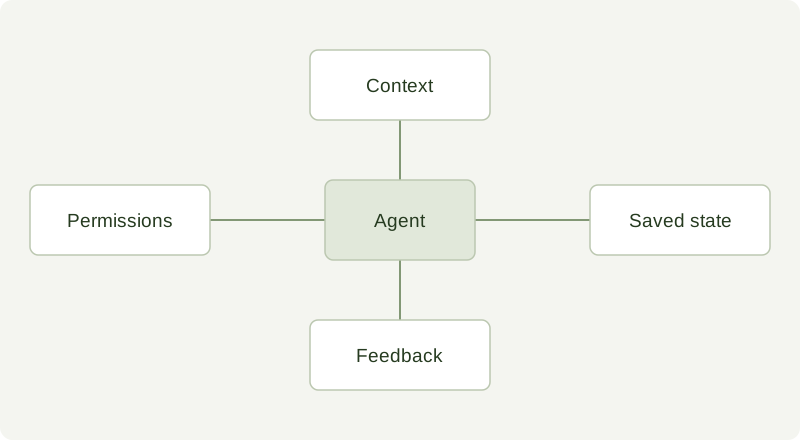
Context, permissions, saved state, and feedback surround the agent. Conceptual architecture.
Give each action a boundary
Reading information, preparing a change, and applying that change carry different responsibilities. An agent that can do the first should not automatically gain permission to do the other two.
Enforce access in the application and its tools. Give the agent enough information to understand those limits, including when it needs approval or must stop. Retrieved documents can provide evidence; they should not be allowed to grant new permissions.
The same discipline applies to context. The agent needs relevant, current material and a way to revisit the source. A large collection of loosely related documents makes it harder to determine which instruction or fact should govern the next action.
Design the interruption as carefully as the answer
A timeout does not always mean an action failed. A service may have accepted a request even though its response never arrived. Repeating the request without checking can create duplicate work.
Record what was attempted and reconcile uncertain outcomes before retrying. Preserve useful intermediate results so a person or a resumed run can continue from a known point.
Make that state visible to the user. “Waiting for approval” and “Unable to confirm the update” are useful statuses because they explain what happens next. A spinning indicator offers no such help. People need a clear result, a clear dependency, or a clear reason the work stopped.
Measure work that people can use
Define completion in terms of the task. A polished response is insufficient when the job also requires correct source material, a saved artifact, or a verified change in another system.
Evaluate those outcomes across repeated runs. Include incomplete inputs, unavailable tools, and revoked access. Turn observed failures into tests before changing the model, prompt, or retrieval setup. Track how much review and correction the result still requires.
TouAI provides building blocks for connecting data, processing unstructured content, and retrieving knowledge. These services help supply the evidence an agent needs. The surrounding application defines how the work proceeds and what counts as complete.
The production milestone is reached when people can delegate a defined task, inspect the result, and handle exceptions without rebuilding the process themselves.