Make your data work for your agents

Your business knowledge is the difference. Give agents a way to use it.
The answer an agent needs may already exist somewhere in your business. Finding it is only half the problem.
A pricing document can be accurate and no longer current. Two reports can use the same metric name for different calculations. A meeting transcript can capture a proposal without recording whether it was approved.
An agent needs these distinctions to do useful work. The value of enterprise data lies in the meaning, history, and authority around it. Making that knowledge available takes more than connecting a folder to a model.
Preserve what makes a fact useful
Information changes as it moves between formats. A table becomes text. A recording becomes a transcript. A document becomes a set of searchable passages. At each step, details can disappear.
Keep the relationships that a reader would need to interpret the material: headers and units for a table, speaker and timing information for a recording, document identity and section context for an excerpt. Preserve the original reference so an answer can be checked.
Business meaning needs similar care. A definition should state where it applies. A decision should be distinguishable from a suggestion. A revision should show which earlier version it replaces. These details help an agent judge whether a source answers the question being asked.
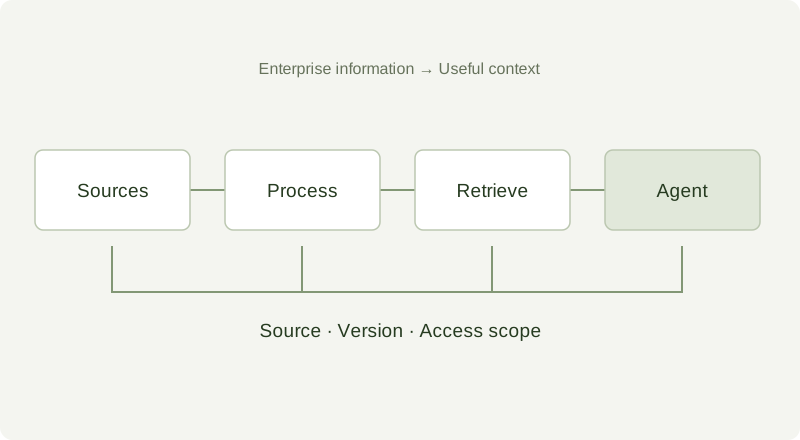
A conceptual path from enterprise information to useful context. Source, version, and access scope travel with the evidence.
Bring in evidence when the task needs it
The goal of retrieval is to supply enough evidence for the next decision. That may be a paragraph, a record, or a live value from a business system.
Exact identifiers benefit from exact lookups. Questions expressed in everyday language may need semantic search. Information that changes frequently may require a fresh read from its source. Retrieval-augmented generation, or RAG, brings selected material into the model’s context as it works.
Keep the path back to the source available. An initial passage may establish relevance without containing everything needed for an answer. The agent should be able to inspect the surrounding material, resolve an ambiguous term, or look for conflicting evidence before reaching a conclusion.
Keep reusable knowledge accountable
A useful answer today can become a misleading answer next month. Products change, documents are replaced, and people lose access to information they once needed.
Treat those changes as part of the data lifecycle. Updates and deletions need to reach indexes, caches, and any summaries that reuse the source. Access checks must apply when information is retrieved, including information derived from restricted material.
Agent-generated notes deserve particular attention. A plausible interpretation can become a repeated mistake if later runs treat it as an established fact. Keep its supporting source and review status visible. Assign ownership to shared knowledge so corrections have somewhere to go.
Find the weak link before changing the model
When an answer is wrong, inspect the evidence that reached the agent. Was the right source available? Did retrieval find it? Did processing preserve the relevant table or paragraph? Did the agent interpret it correctly?
Separating these questions makes improvements more precise. Better retrieval cannot repair a missing unit. A longer prompt cannot update an obsolete policy. Measure source selection and answer quality separately, using questions your team actually needs answered.
TouAI brings together Connectors for external sources, Unstructured for multimodal content, and Knowledge Base for indexing and search. Web Access and Deep Research support work that also needs external information.
Start with knowledge people already trust and use. Make it understandable, keep it current, and preserve its access boundaries. Your agents become more useful when they can work with the distinctions your business already knows matter.