Enterprise AI needs a deployment strategy

Decide where intelligence runs, where information travels, and who remains in control.
An agent can run inside your network while the information it uses travels outside it.
Tool execution, model inference, storage, and monitoring are separate parts of an AI system. Moving one into a private environment does not necessarily move the others. A deployment label tells you less than a map of the actual request.
An enterprise AI deployment strategy should make that map clear. It should also establish who operates each part, who can change it, and what happens when the arrangement no longer fits the business.
Decide what must stay under your control
Begin with the work the agent will perform and the information it will touch. Some tasks need access to internal systems. Others depend on specialized hardware, a particular network, or data that must remain within a defined environment.
Turn those requirements into specific architecture decisions. Identify where files are processed, where the model runs, where intermediate results are saved, and who can access each location. Include support access and diagnostic records in that picture.
Different components may belong in different places. The useful question is whether the complete arrangement meets the requirement and can be operated by the people responsible for it.
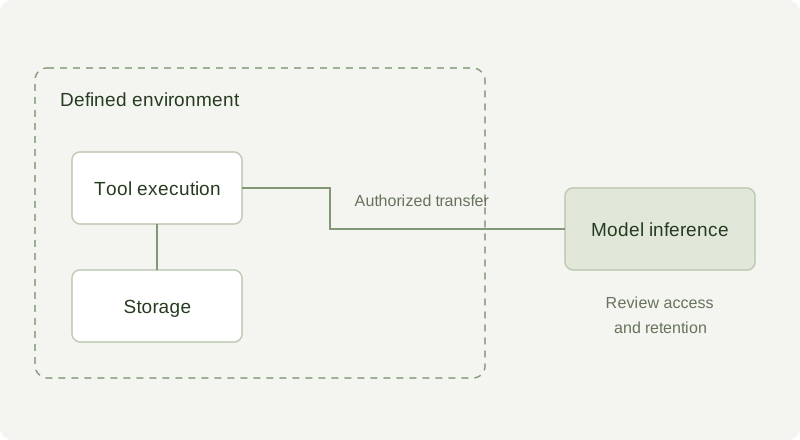
A conceptual deployment boundary. Review what crosses it, who authorizes the transfer, and what each destination retains.
Follow the request all the way through
An uploaded file is only the beginning of a data path. Extracted passages may enter a prompt. Tool responses may appear in a transcript. Debugging information may be copied into logs. Each destination needs an explicit purpose and handling policy.
Review normal operation and failure paths. A fallback model can introduce another destination. A retry can create another retained copy. A troubleshooting session can expose information that never appears in the final answer.
A clear boundary diagram makes these decisions easier to review. Mark which transfers are allowed, what they contain, and what each receiving service retains. Then verify the configuration against that diagram. An architecture document is useful only while it describes the system that actually runs.
Put names against operating responsibilities
Ownership of infrastructure and responsibility for operating software are different decisions. A company can own a cloud account while a service provider maintains components inside it. Running everything internally still leaves someone responsible for patches, capacity, recovery, and support.
Specify who can approve a release, change a model route, access diagnostic data, and restore service. Make escalation paths usable by the team that will be on call. Ambiguity becomes expensive when several operators are investigating the same incident.
Compare deployment options against that operating burden. More direct control can be valuable, but only if the organization can maintain it. A managed arrangement needs equally clear limits on the access and changes delegated to the provider.
Preserve room to change
The first deployment is unlikely to be the last. Usage grows. Models change. An agent that begins by drafting recommendations may later gain authority to update a business system.
Review those changes before expanding access. Keep a known working configuration and a way to stop new actions. Preserve records of completed actions, because rolling back software does not undo a change already made elsewhere.
Plan for portability as well. Know how to export the organization’s data, instructions, and useful outputs. Identify dependencies that would make a future migration difficult. The ability to change direction is easier to preserve before those dependencies accumulate.
For an architecture that uses TouAI, confirm hosting, networking, data handling, and support arrangements for the proposed configuration. Match each service to the task and its operating requirements.
A sound deployment strategy leaves the organization able to explain where information goes, operate the system through a failure, and make the next change deliberately.